


I’ve removed data literacy from my AI leadership framework

Updated: Aug 13
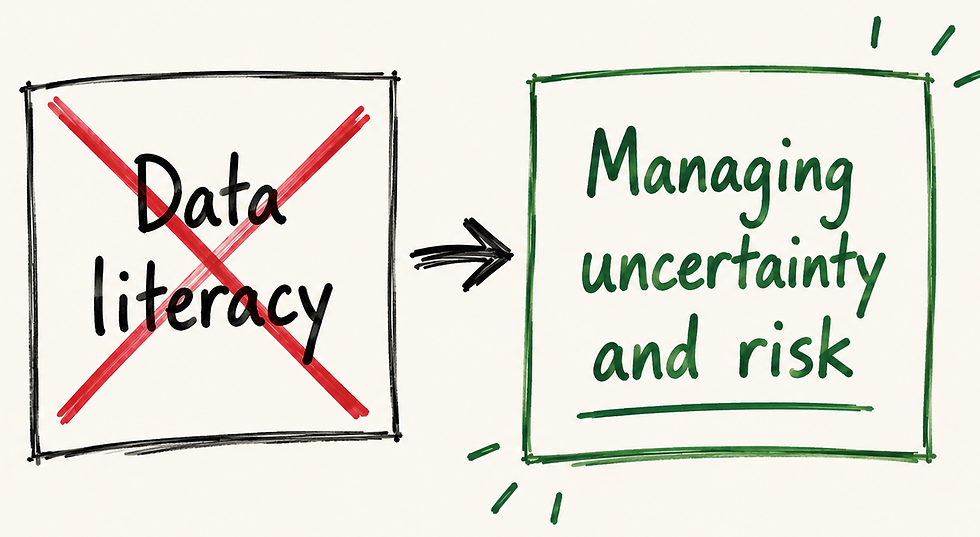
For the past 18 months, one of my five skill groups for leaders in the age of AI has included systems thinking, critical thinking and data literacy.
I no longer think data literacy deserves that place. I have replaced it with managing uncertainty and risk.
Data literacy still matters, of course. But agentic AI has changed what leaders most urgently need to understand.
AI agents do more than generate answers. They can act, operate across systems and pass work between one another, often at considerable speed.
Their mistakes may be plausible rather than obvious, and when a system performs well for long enough, people gradually stop checking. That is when automation bias can become cognitive surrender.
This does not mean that leaders need to become AI risk specialists or start designing agents themselves. However, it does mean that some questions about their design have become strategic.
What authority has been delegated? Where are its limits? Can actions be traced and audited? How will we notice when behaviour changes? Can we intervene? Can we reverse what has happened, or at least recover from it?
Many years ago, I inherited a major banking programme in which a project had accidentally deleted the bank's standing order and direct debit records. Recovery involved finding an old backup and printing thousands of pages for branches.
After that, I began asking one question before any IT change, whenever the consequences of failure were serious: Can we reverse this and how quickly?
That was not an attempt to interfere in technical design. It was a leadership responsibility. Some risks are important enough that a leader needs to descend into the detail until they are satisfied.
One of the most useful leadership disciplines I learned from my old boss, Geoff Williams. When someone said that an important issue was covered, Geoff would say:
“Good. I trust you. But show me how.”
Once satisfied, he stepped back again.
I think agentic AI requires more of that kind of leadership. Organisations will increasingly delegate authority to agents. Leaders need to understand the risks well enough to insist that limits, monitoring, traceability, intervention and recovery are designed in from the outset.
At this specific moment in the development of AI, managing uncertainty and risk is not a specialist addition to leadership. It is foundational.
Leadership Skill Builder is the practical expression of this skills framework.
Comments